
Inksights Blog : The Reputation Ink Blog
AEC Firms Can’t Out-BD a Weak Marketing Strategy

By Michelle Calcote King | Read more by this author
7.31.26
Why Relying Too Heavily on Business Development Can Backfire
AEC firms are under increasing pressure to maintain a steady flow of opportunities. Inbound interest isn’t as consistent as it once was, competition has intensified, and buyers are taking more time to evaluate their options before engaging.
In response, many firms are doubling down on business development. Principals and seller-doers are being asked to attend more events, schedule more meetings and stay in closer contact with prospects and referral sources.
That approach makes sense. Business development has always been central to how AEC firms grow, and relationships remain a critical driver of new work. But in many cases, business development is being asked to carry more of the load than it should.
When marketing is inconsistent or underdeveloped, business development has to compensate:
- Conversations start colder.
- Seller-doers spend more time explaining the firm’s value.
- Opportunities depend more heavily on individual relationships and timing.
That dynamic makes growth harder to sustain.

“Business development helps generate opportunities in the near term. Marketing creates the conditions that make those opportunities easier to win over time.”
Why AEC firms default to business development
There are good reasons firms lean on business development. It produces visible activity. Meetings get booked, relationships deepen, and opportunities move forward. Firm leaders can see the effort and connect it directly to potential revenue.
It also aligns with how the industry has traditionally operated. AEC firms have long relied on relationships, reputation and trust built over time.
Data supports that reality. According to Zweig Group, most AEC firms rely on seller-doers to drive business development, largely because clients want direct access to the professionals who will deliver the work.
The challenge is that many firms treat it as the primary, and sometimes only, growth strategy.
The limits of the seller-doer model
Seller-doers play a valuable role in business development by bringing technical expertise to client conversations. They can speak directly to project challenges, offer informed perspectives and build trust with sophisticated buyers.
At the same time, they are responsible for delivering projects, managing teams and maintaining client relationships. That creates a constraint.
Growth becomes tied to:
- The time seller-doers have available
- The strength of their existing networks
- Their level of comfort with business development
- Their ability to stay visible while managing project work
These professionals are already balancing significant responsibilities. Adding more business development activity can stretch them too thin, especially when they are also expected to explain and promote the firm without much marketing support.
Why business development doesn’t scale on its own
Business development depends heavily on effort. When seller-doers actively network and follow up, the pipeline tends to grow. When that activity slows, opportunities often follow suit.
This creates a cycle where constant motion is required to maintain momentum. Growth becomes tied to the amount of outreach occurring at any given time, and that outreach is usually concentrated among a small group of individuals.
Another challenge is that each new opportunity often starts with limited context. Prospects may not be familiar with the firm, its experience or its point of view. Seller-doers must build that understanding from the ground up in each conversation.
That approach can produce results, but it rarely creates lasting momentum. Business development can keep work coming in. It does not, on its own, build broader awareness or make future opportunities easier to generate.
What marketing does differently
Marketing helps create familiarity before a direct conversation ever happens.
In AEC, where projects are complex and decisions carry significant risk, buyers spend time learning about firms well in advance of a formal pursuit. They look for signals of expertise, credibility and experience. Marketing makes those signals visible.
Through thought leadership, media coverage, speaking engagements, project storytelling and consistent content, firms can demonstrate how they think and how they approach their work.
This visibility changes the starting point for business development. Instead of beginning with a blank slate, seller-doers engage prospects who may already recognize the firm’s name, understand its expertise or have encountered its insights.
“Marketing also extends the reach of your firm’s expertise. A single idea can be shared across multiple channels, reaching far more people than one-to-one outreach alone. In that sense, marketing functions as relationship-building at scale. It creates familiarity, reinforces credibility and keeps your firm top of mind for buyers and referral sources, even when your team isn’t in the room.”
That delayed and compounding effect is also why some firms mistakenly conclude that “marketing didn’t work.” Unlike business development, which produces immediate and visible activity, marketing often influences opportunities long before a prospect reaches out or a pursuit begins. Its value builds over time, strengthening recognition, credibility and trust across the market in ways that make future business development efforts more effective.
What happens when firms rely too heavily on BD
When business development becomes the primary growth engine, several issues tend to surface.
Pipeline quality can become inconsistent, influenced by individual networks and timing. Growth may depend on a small group of high-performing rainmakers, creating risk if those individuals step back or leave the firm.
Firms may also find themselves entering the conversation later than they would like, often at the RFP stage or after competitors have already built relationships and credibility with the client.
Without marketing to support early visibility, firms often react to opportunities rather than help shape them.
Build for balance: today and tomorrow
Strong AEC firms do not rely exclusively on either marketing or business development. Business development builds relationships one conversation at a time. Marketing builds those same relationships at scale, creating a broader base of familiarity that BD can then deepen. Together, they create a more sustainable growth model.
Marketing ensures that when prospects encounter your firm — whether through content, media coverage, speaking engagements or industry recognition — they are not only aware of who you are, but have reasons to believe you can deliver on what you claim.
That matters in AEC, where buyers are managing risk as much as they are selecting partners.
By the time a business development conversation begins, marketing should have already helped answer key questions:
- Does this firm have relevant experience?
- Do others recognize them as credible?
- Do they think about problems the way we do?
Business development then builds on that foundation, turning familiarity and credibility into trusted relationships and, ultimately, new work.
Firms that invest in both BD and marketing don’t just generate more opportunities — they improve the quality of those opportunities and the likelihood of winning them. Over time, that creates momentum: growth supported by visibility, credibility and a stronger market position, not just effort.
Make Your Expertise Easier to See and Choose
Business development will always play a central role in AEC growth. The firms that gain an advantage are the ones that make those conversations easier from the start.
That often comes down to storytelling: how clearly you communicate your experience, your thinking and your value to the market.
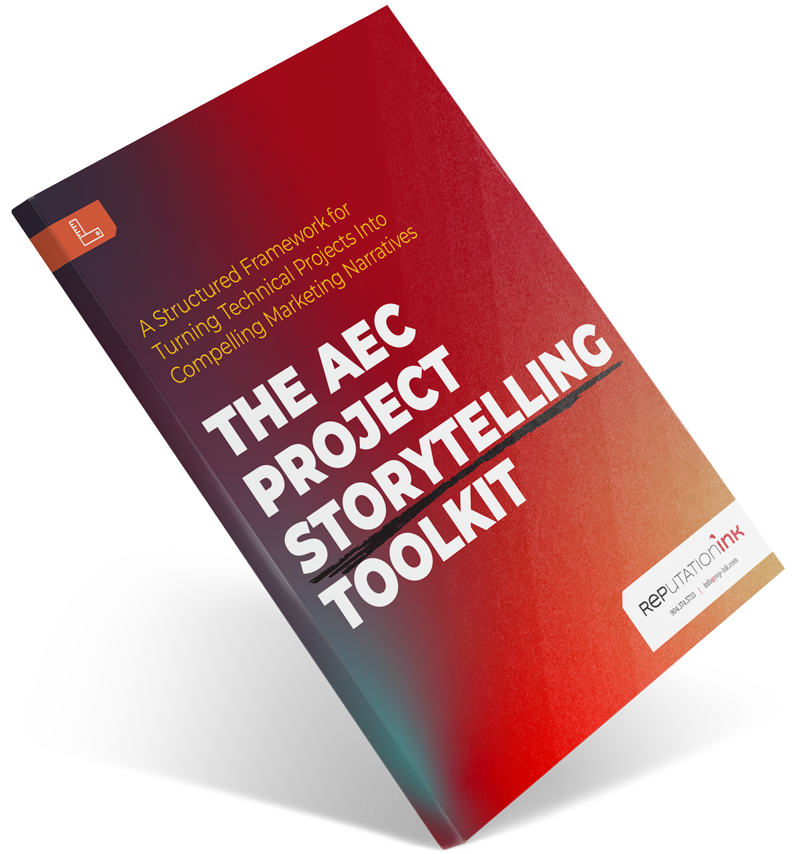
We’ve created practical tools to help AEC firms improve how they tell their stories, including a project storytelling questionnaire, a client-as-hero framework and ready-to-use templates.
Related AEC Content
Building a Bold Brand for an Award-Winning Women in Construction Initiative
Jessi Bruton | Jul. 22, 2026

From Occasional Commentary to a Consistent Thought Leadership Program
Reputation Ink | Mar. 19, 2026