Inksights Blog : The Reputation Ink Blog
Mastering the Art of AEC Project Storytelling

By Michelle Calcote King | Read more by this author
3.31.26
The public meeting is standing-room only.
Residents line up at the microphone to voice frustration about a crumbling transit hub. The facilities director sits quietly in the front row, knowing the next decision could define her career.
Or maybe it’s 6 a.m. on a jobsite the morning of a scheduled concrete pour. The wind is picking up. The schedule is already tight. There’s no margin for error.
If you work in architecture, engineering or construction (AEC), you’ve lived some version of this. And yet, when firms tell these stories publicly, they don’t sound like this at all. They sound like:
- “Delivered 200,000 square feet.”
- “Completed on time and on budget.”
- “Achieved LEED Silver certification.”
Important? Yes. Memorable? Not even close.

“In a crowded market where technical competence is assumed and collaboration is expected, functional differences are difficult for buyers to see.
What cuts through? Storytelling.”
A social experiment that proves the point
In 2009, Rob Walker and Joshua Glenn launched the Significant Objects Project. They purchased 100 thrift-store trinkets for a total of $129. Then they asked professional writers to create fictional backstories for each object.
For example, a heart-shaped paperweight was accompanied by a tale about an office manager who used it to weigh down the lid of her M&M jar.
Then, they relisted the items on eBay with the stories included.
Total sales? Nearly $3,600 — a profit of over 2,700%. Nothing about the objects changed. Only the narrative.
That’s the power of story: it creates meaning — and meaning creates perceived value. And yes, it works in AEC.
B2B buyers are more emotional than you think
In a widely cited study by Google, CEB (now Gartner) and Motista, more than 3,000 B2B buyers were surveyed across 36 brands. The conclusion surprised many marketers: B2B buyers are often more emotionally connected to brands than B2C buyers.
Why? Because business decisions carry more risk.
They impact budgets, safety, timelines, reputation and careers. When clients hire an AEC firm, they aren’t just purchasing services. They’re making a decision that could define their professional credibility.
Which leads to the real enemy in AEC marketing: the status quo.
The real enemy: Inaction
If prospects seem more cautious, you’re not imagining it. Behavioral economics calls it loss aversion: when the fear of making the wrong decision outweighs the excitement of making the right one.
In AEC, that often leads to:
- Choosing the incumbent
- Selecting the lowest perceived risk, or
- Delaying the decision altogether
“If your marketing only says, “Hire us to win,” you miss the psychological reality of your buyer. A stronger message is: “Here’s how people like you chose us and felt proud, safe and smart doing it.”
That shift — from project features to human reassurance — is where storytelling becomes strategic.
For example, to build emotional safety, tell stories of real people, with real risks and real outcomes, who’ve chosen you and succeeded. Make it clear that your clients don’t just survive the decision, they shine because of it. Make sure to focus on personal value: Demonstrate how working with your firm helps clients advance their careers, gain recognition and build trust internally.
Storytelling helps create familiarity before the ask. By being present with helpful stories well before buyers are ready to choose, you build familiarity and reduce perceived risk.
The anatomy of a great AEC story
Every compelling project story includes a few essential elements:
A relatable hero
This is your client — a city planner under public pressure, a hospital administrator facing capacity issues, a developer navigating permitting challenges.
Your firm is never the hero. The client is. They carry the risk and the opportunity. When you center them, your audience sees themselves in the narrative.
A guide
That’s you, the AEC firm.
You bring clarity, experience and reassurance. You’ve navigated similar terrain before. You provide structure and judgement without stealing the spotlight.
A clear goal
Deliver a net-zero building. Complete a bridge under an aggressive timeline. Revitalize a struggling district.
Conflict
Budget constraints. Supply chain breakdowns. Community pushback. Regulatory complexity. The status quo.
Dig into the details with your project managers. Ask them about the challenges, constraints or obstacles the project faced.
Emotional stakes
What did success mean beyond the specs? Community pride? Student learning? Public safety? Career advancement? These are the human reasons your work matters.
Transformation
The ribbon is cut. The structure performs as designed. Stakeholders are thrilled. The story ends with impact and proof of success.
Bring it to life: A derelict site becomes a civic centerpiece. A chaotic jobsite becomes a model of safety. A vision becomes a legacy project. That transformation is the payoff.
Why the hero’s journey works in AEC
The hero’s journey is a timeless storytelling structure.
1. It mirrors how people actually experience decisions
In business, especially in AEC:
- A client faces a problem (a crumbling building, public opposition, a complex regulation).
- They set out to solve it.
- They face uncertainty, obstacles and risk.
- They seek guidance from experts (that’s your AEC firm).
- They return with a solution that elevates them and their business or community.
2. It shifts the focus away from you
In AEC marketing, it’s tempting to lead with awards, capabilities and portfolios. But those are “guide” things (aka, all about you).
Instead, the hero’s journey reframes the client as the protagonist, with you as the guide who helps them win. That emotional framing is what builds trust, especially when all vendors feel the same, buyers are afraid of choosing the wrong one, and risk and pressure are high.
3. It creates emotional stakes in logical decisions
AEC buyers are smart, analytical people, but they still make emotional decisions. They want to be seen as visionary, competent and respected. They want to avoid failure, backlash and embarrassment. The hero’s journey helps them imagine what success feels like, not just how specs stack up.
4. It’s deeply familiar even if people don’t realize it
From Star Wars to Pixar to the Bible to TED Talks, the hero’s journey is ingrained in us. Audiences instinctively lean in because they recognize the pattern, whether consciously or subconsciously.
5. It gives structure to complex B2B narratives
AEC stories can be complicated: technical specs, varying stakeholders, community impact, compliance. The hero’s journey simplifies that complexity into a clear, repeatable structure:
- Challenge
- Struggle
- Guidance
- Breakthrough
- Victory
Craft scenes, not just summaries
Great storytelling lives in specifics — human moments, dialogue and sensory detail. Consider the following:
Before (non-story-driven)
The firm designed a 200,000-square-foot community center that achieved LEED Silver certification and features flexible public-use areas.
After (story-driven)
In the early design charrette, our lead architect noticed a quiet mom sketching with her toddler in the margins of a community survey. “I just want a place where I don’t have to whisper,” she said. That one sentence shaped our entire vision for the space — now a sun-filled atrium with acoustic buffers and reading nooks. Today, that mom volunteers at the center’s front desk every Thursday.
Or this:
Before (non-story-driven)
Our team engineered a new stormwater management system that increased site runoff efficiency by 37% and ensured compliance with all EPA regulations.
After (story-driven)
The morning after a major storm, our site engineer, Melissa, waded knee-deep through runoff behind the school to inspect a failing retention pond. She snapped a photo of a third grader’s backpack floating in the overflow and said, “That’s why we need to get this fixed, fast.” Three months later, that same kid rode his bike across a dry, grassy bioswale that now handles the runoff naturally and safely.
The difference is not the data. It’s in the humanity.
Before (non-story-driven)
IronBridge completed a $14M bridge replacement project on schedule, with minimal impact to traffic and zero safety incidents.
After (story-driven)
During the third week of night pours, our superintendent, Troy, brought hot coffee out to the crew at 3 a.m. and pointed to the flicker of brake lights backing up past the detour. “That’s a mom getting off a double shift,” he said. “She’s counting on us to finish this right.” We did — six days early. That stretch of road now carries 26,000 cars a day, and Troy still waves from the jobsite every time he sees a school bus pass.
Communicate meaning from data
Data is essential in AEC. It proves performance, validates expertise and builds credibility. But data alone rarely persuades. A statistic without context is just a number. What moves people is what that number means.
The shift begins with a simple question: so what?
Before presenting any metric, ask yourself what it changes for the audience. What does this percentage, this savings, this timeline actually represent in human terms?
Saying, “We reduced energy use by 35%” is accurate, but it leaves the listener to interpret it. Saying, “That 35% drop in energy use saved the school district $1.2 million, enough to fund 25 new teachers,” completes the thought. It translates efficiency into impact. It connects performance to people.
The same principle applies to leasing velocity, safety metrics and occupancy rates. “98% of units leased within 60 days” is impressive. But when you add the scene — families lined up to move in, affordable housing meeting urgent demand — the number becomes proof of purpose. Data shows what happened, whereas a story shows who it happened to and why it matters.
Some metrics are also difficult to visualize. Saving 40,000 gallons of water may seem substantial, but few people intuitively grasp its scale. When you say, “We saved enough water to fill three Olympic-size pools,” you make the abstract tangible. Analogies and visual language help your audience see what you see.
And whenever possible, give the data a voice. A quote from a facilities manager, a city official or a project stakeholder adds texture and authenticity. When someone says, “We haven’t just saved on utilities — we’ve finally hit our sustainability targets,” the result feels lived rather than simply reported.
Ultimately, numbers should make people feel something. Relief that a project met code and beat the clock. Pride in earning recognition for workplace culture. Concern over the cost of inefficiency. Hope that savings can fund additional community investments.
While data earns attention, meaning earns trust. When you pair the two, your statistics become evidence of transformation.
Storytelling in AEC case studies
Most AEC case studies read like technical summaries:
- Project size
- Budget
- Schedule
- Certifications
- Awards
Important? Yes. Memorable? Rarely.
A story-driven case study frames the journey:
- What problem was the client trying to solve?
- What was at risk?
- What tension emerged?
- What breakthrough made the difference?
- What changed for the client, the users or the community?
Beginning → Middle → End beats Scope → Specs → Stats every time.
Before (non-story-driven)
Urban Living Partners Affordable Housing Project
- Delivered a 200-unit affordable housing project in Austin.
- Stayed 15% under budget.
- Achieved LEED Gold certification.
- Addressed neighborhood concerns and secured community approvals (85% approval).
- Received the 2024 AIA Southwest Design Award.
We provided architectural design services and applied sustainable materials and design best practices. We worked with developers and municipalities to deliver an affordable housing solution.
After (story-driven)
Transforming Affordable Housing with Urban Living Partners
When Urban Living Partners approached Form+Function Studio, they faced a challenge that many affordable housing developers know well: how to build a 200-unit complex that delivered both affordability and architectural integrity — all on a constrained urban site and under intense public scrutiny.
Rather than take the typical “minimum viable” approach, Form+Function saw an opportunity to reimagine what affordable housing could look like. Acting as a true collaborator with developers, local officials, and community advocates, our team leaned into human-centered design, incorporating resident feedback sessions and community workshops into the process.
Storytelling in AEC proposals
Technical competence gets you shortlisted. However, emotional alignment gets you selected. Compare these two openings:
Before (non-story-driven)
“We are a 200-person architecture firm with a 40-year legacy of award-winning work.”
After (story-driven)
“You’re not just building a facility. You’re shaping a space that will influence lives for decades. Our role is to help you bring that vision to life — while navigating the regulatory, budgetary and community pressures that come with it.”
One lists credentials. The other demonstrates understanding.
Storytelling in AEC bios
Even team bios can shift from résumé to character.
Before (non-story-driven)
Luis Delgado, PE – Structural Engineer
Luis Delgado, PE, is a Structural Engineer with expertise in designing resilient and efficient structural systems. He played a key role in the Bayline Pier Redevelopment project and regularly collaborates with design teams to ensure structural integrity and code compliance across a variety of project types.
After (story-driven)
Luis Delgado, PE – Structural Engineer
Luis believes engineering isn’t just about load paths — it’s about enabling architectural vision. His work on the Bayline Pier Redevelopment earned praise for integrating resilience features without compromising aesthetics. He’s a translator between design intent and physical reality, ensuring creative ideas are buildable, efficient and code-compliant.
That subtle shift builds connection.
Why storytelling matters more in the age of AI
I can’t write a marketing blog post in the Year of our Lord 2026 without acknowledging AI. I know — cue the collective sigh.
But this isn’t another breathless take about tools and prompts. It’s a more important point: as our feeds fill with AI-generated content, storytelling becomes more valuable, not less.
AI can generate content at scale. It can summarize specs, rephrase capabilities and produce endless variations of “trusted partner” in seconds.
What it cannot replicate is lived experience.
As content volume increases, meaning becomes scarce. The firms that win in the next decade won’t simply publish more information. They will create more resonance. They will communicate not just what they build, but why it matters.
AI delivers information. Storytelling delivers emotion. And in industries like AEC, emotion drives trust. People buy with emotion and justify with logic.
So, where to begin? You don’t need to become a novelist. But you do need a structured way to extract better stories from your projects.
Continue gathering the foundational details — square footage, services provided, delivery method, schedule and certifications. Those establish credibility.
But if you want your content to move beyond “what we built” and toward “why it mattered,” start with better questions. Because stronger stories don’t happen by accident; they result from asking the right ones.
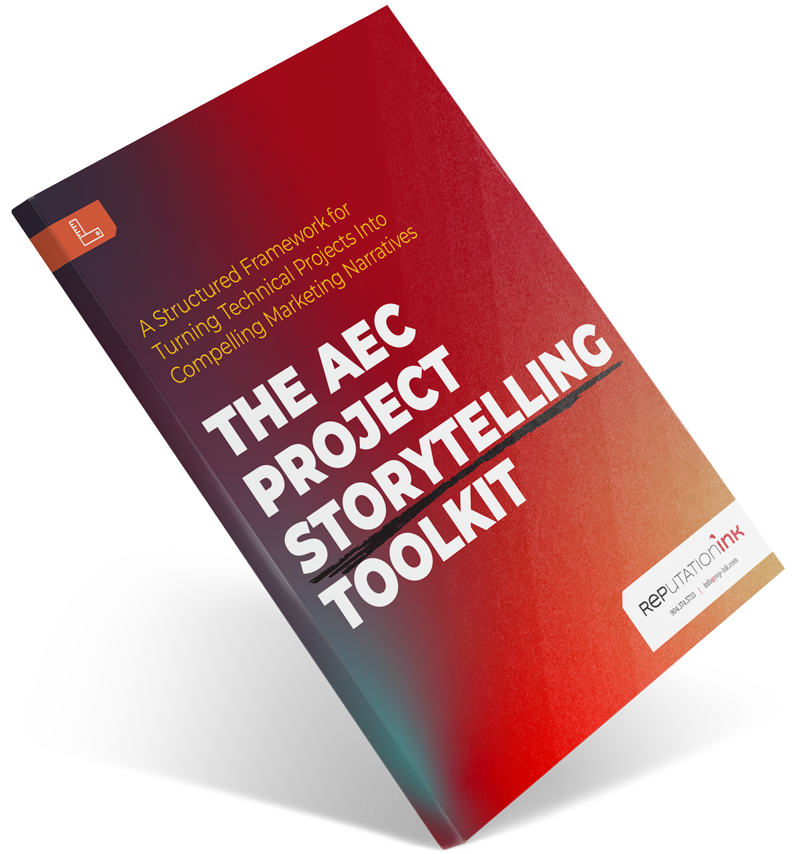
Our AEC Project Storytelling Toolkit helps you:
- Surface the real tension behind a project — not just the timeline and budget
- Identify who carried the risk and what was at stake
- Capture defining moments, setbacks and breakthroughs
- Translate data into human impact
- Uncover decision psychology and emotional drivers
- Align project stories with your firm’s positioning
- Turn interviews into stronger proposal narratives, blog posts and marketing assets
Related AEC Content

From Occasional Commentary to a Consistent Thought Leadership Program
Reputation Ink | Mar. 19, 2026

Maximizing Employee Engagement Through a Compelling Employee Newsletter
Reputation Ink | Jun. 24, 2025